

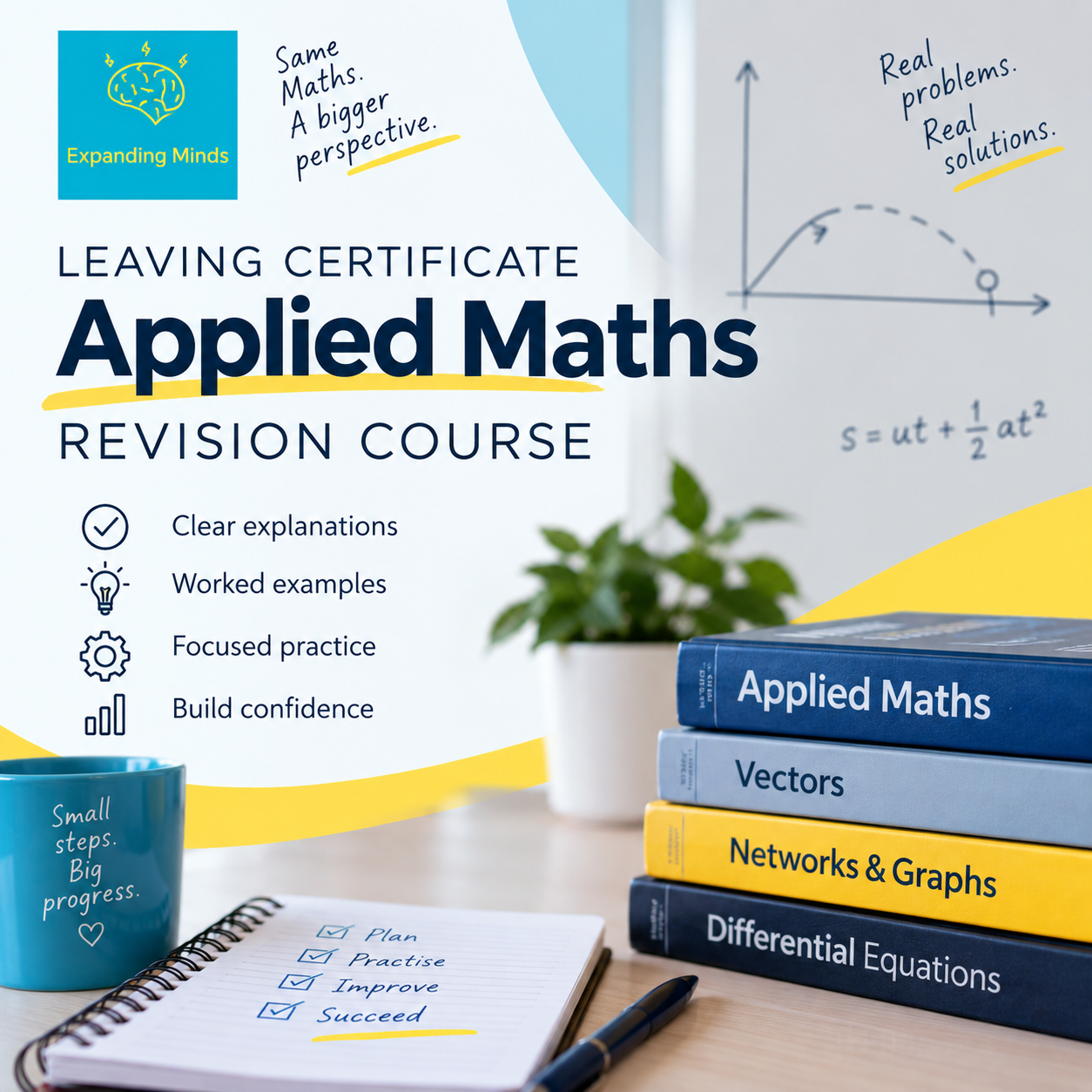
About Course
Master the Leaving Certificate Higher Level Applied Maths course with clear, structured lessons designed to support you from the beginning of 5th Year right through to exam day.
This course is organised by strand and topic, making it easy to learn new material, revisit challenging concepts or focus your revision before exams.
Inside the course you’ll find:
- Step-by-step video lessons covering the full Higher Level course
- Topic-by-topic revision organised exactly as you study it
- Past examination questions grouped by topic
- Fully worked video solutions to exam questions
- Additional exam questions from the old course for extra practice
- Additional resources and guidance to build confidence and improve exam performance
Whether you are learning a topic for the first time, catching up after missing class, or aiming for an H1, this course gives you everything you need in one organised place.
What Will You Learn?
- Revise the key topics on the Leaving Certificate Higher Level Applied Mathematics course.
- Develop a deeper understanding of mathematical concepts and problem-solving techniques.
- Work through past examination questions with detailed, step-by-step solutions.
- Learn how to approach unfamiliar questions and apply mathematical methods confidently.
- Identify common mistakes and improve examination technique.
- Build confidence and prepare effectively for the Leaving Certificate Applied Mathematics examination.
Course Content
TOPIC 1: Mathematical Modelling & the Modelling Project
Strand 1: Mathematical Modelling. Develop your understanding of mathematical modelling and how it underpins the entire Applied Maths course. Explore the modelling process and get practical guidance for approaching the Mathematical Modelling Project.
Assessment Focus: The Mathematical Modelling Project is worth 100 marks, or 20% of the overall Leaving Certificate Applied Maths grade. Mathematical modelling also underpins the written examination and is applied across all four strands.
-
Lesson 1.1 – Mathematical Modelling Project Tips
53:49
TOPIC 2: Networks & Graphs
Strand 2: Mathematical Modelling with Networks and Graphs
Develop the skills needed to solve problems involving networks, graphs, algorithms and scheduling. This section covers the key techniques and approaches needed for Leaving Certificate Higher Level Applied Maths.
Recent Exam Focus: Networks & Graphs has featured on every Higher Level paper from 2023–2026. Including Minimum Spanning Trees, this area has accounted for approximately 35 marks per paper on average, equivalent to about 9% of the 400 marks answered.
-
Lesson 2.1 – Introduction to Networks
36:44 -
Lesson 2.2 – Matrix Multiplication
48:04 -
Lesson 2.3 – Minimum Spanning Trees
41:47 -
Exam Practice | 2026 Q1(a)(i) – Minimum Spanning Trees
08:21 -
Exam Practice | 2025 Q3(b) – Minimum Spanning Trees
06:47
TOPIC 3: Shortest & Optimal Paths
Strand 2: Mathematical Modelling with Networks and Graphs.
Explore algorithms for finding shortest and optimal routes through networks. You will learn how to select and apply appropriate methods to solve different types of network optimisation problems.
Recent Exam Focus: Shortest & Optimal Paths has featured on every Higher Level paper from 2023–2026, through Dijkstra's Algorithm and/or Dynamic Programming. It has accounted for approximately 30 marks per paper on average, equivalent to about 7% of the 400 marks answered.
-
Lesson 3.1 – Dijkstra’s Algorithm
41:53 -
Lesson 3.2 – Dynamic Programming: From Graphs [Bellman’s Principle of Optimality]
51:20 -
Lesson 3.3 – Dynamic Programming: From Tables
01:08:27 -
Review of all Algorthims
52:05 -
Exam Practice | 2026 Q1(a)(ii)(iii) – Dijkstra’s Algorithm
13:54 -
Exam Practice | 2025 Q6(a) – Dynamic Programming
16:19 -
Exam Practice | 2025 Q7(a) – Dijkstra’s Algorithm
14:11
TOPIC 4: Activity Networks & Scheduling
Strand 2: Mathematical Modelling with Networks and Graphs
Learn how activity networks are used to model, plan and analyse projects. You will develop the skills needed to construct activity networks and solve scheduling problems.
Recent Exam Focus: Activity Networks & Scheduling appeared in 3 of the 4 Higher Level papers from 2023–2026, accounting for approximately 35 marks per paper on average across the four years. When examined, it has often represented a substantial part of a question or a full question.
-
Lesson 4.1 – Introduction to Activity Networks & Scheduling
01:54:27 -
Lesson 4.2 – Drawing Activity Networks
23:05 -
Exam Practice | 2026 Q2(i) – Activity Networks
07:06 -
Exam Practice | 2026 Q10 – Scheduling
26:33
TOPIC 5: Vectors & Units
Strand 3: Mathematically Modelling the Physical World – Kinematics and Dynamics.
Develop the vector and dimensional analysis skills used throughout Applied Maths. Learn how to work with vectors, the dot product, units and resolving vectors in context.
Recent Exam Focus: Vectors and dimensional analysis have appeared in 3 of the 4 Higher Level papers from 2023–2026. Direct questions have accounted for approximately 15 marks per paper on average, but these skills also support work across mechanics and other areas of the course.
-
Lesson 5.1 – Vectors & the Dot Product
38:28 -
Lesson 5.2 – Resolving Vectors in Context
59:40 -
Lesson 5.3 – Dimensional Analysis
58:56 -
Exam Practice | 2025 Q5(b) – Vectors
05:51
TOPIC 6: Uniform Acceleration
Strand 3: Mathematically Modelling the Physical World – Kinematics and Dynamics
Build a strong understanding of motion with constant acceleration. You will learn how to analyse horizontal and vertical motion and interpret velocity-time graphs.
Recent Exam Focus: Uniform Acceleration has featured on every Higher Level paper from 2023–2026, accounting for approximately 30 marks per paper on average, or about 8% of the 400 marks answered. It also frequently appears alongside other mechanics topics.
-
Lesson 6.1 – Introduction to Uniform Acceleration
33:53 -
Lesson 6.2 – Horizontal Linear Motion
45:13 -
Lesson 6.3 – Velocity-Time Graphs
59:22 -
Lesson 6.4 – Vertical Linear Motion
41:55 -
Lesson 6.5 – Deriving Kinematic Equations of Motion Using Calculus
14:07 -
Exam Practice | 2026 Q6(b) – Uniform Acceleration
05:46 -
Exam Practice | 2025 Q9(a) – Uniform Acceleration
10:44 -
Exam Practice | 2023 Deferred Q6(a) – Uniform Acceleration
12:04
TOPIC 7: Projectiles
Strand 3: Mathematically Modelling the Physical World – Kinematics and Dynamics.
Develop the skills needed to model and solve projectile motion problems, progressing from the basic principles to more challenging Higher Level applications.
Recent Exam Focus: Projectiles has featured on every Higher Level paper from 2023–2026, accounting for approximately 38 marks per paper on average, or about 9% of the 400 marks answered. It commonly appears as approximately half a question, although it has also accounted for a full question or appeared in more than one question.
-
Lesson 7.1 – Basics of Projectiles
45:58 -
Lesson 7.2 – Higher Level Projectiles
01:32:39 -
Exam Practice | 2026 Q9(b) – Projectiles
10:14 -
Exam Practice | 2025 Q7(b) – Projectiles
16:47 -
Exam Practice | 2025 Q10(b) – Projectiles
09:19
TOPIC 8: Forces & Connected Particles
Strand 3: Mathematically Modelling the Physical World – Kinematics and Dynamics.
Learn how to analyse forces and the motion of connected systems. Explore connected particles, pulley systems, inclined planes, work, energy and power, Hooke’s Law and force-based models.
Recent Exam Focus: Forces & Connected Particles has featured on every Higher Level paper from 2023–2026, accounting for approximately 50 marks per paper on average, equivalent to a full question or 12.5% of the 400 marks answered. Questions may also connect this area with energy, Hooke's Law and differential equations.
-
Lesson 8.1 – Introduction to Connected Particles
49:55 -
Lesson 8.2A – Types of Pulley Systems
03:42 -
Lesson 8.2 – Pulley Systems
01:20:34 -
Lesson 8.3 – Pulley Systems with Scale Pans
22:11 -
Lesson 8.4 – Collisions Between Connected Particles
37:06 -
Lesson 8.5 – Inclined Planes
01:34:30 -
Lesson 8.6 – Work, Energy & Power
01:10:03 -
Lesson 8.7 – Creating Differential Equations from Forces
24:31 -
Lesson 8.8 – Hooke’s Law, Including Calculus
01:02:30 -
Exam Practice | 2026 Q3 – Connected Particles
15:02 -
Exam Practice | 2025 Q3(a) – Connected Particles
11:18 -
Exam Practice | 2025 Q5(a) – Connected Particles
21:03 -
Exam Practice | 2025 Q6(b) – Hooke’s Law
09:11
TOPIC 9: Circular Motion
Strand 3: Mathematically Modelling the Physical World – Kinematics and Dynamics.
Develop your understanding of objects moving in circular paths. Progress from the fundamentals of horizontal circular motion to more challenging horizontal and vertical circular motion problems.
Recent Exam Focus: Circular Motion has featured on every Higher Level paper from 2023–2026, accounting for approximately 50 marks per paper on average, equivalent to a full question or about 13% of the 400 marks answered. Both horizontal and vertical circular motion have featured.
-
Lesson 9.1 – Introduction to Horizontal Circular Motion
01:09:32 -
Lesson 9.2 – Higher Level Horizontal Circular Motion
01:19:17 -
Lesson 9.3 – Vertical Circular Motion
01:17:45 -
Exam Practice | 2026 Q5 – Circular Motion
20:14 -
Exam Practice | 2025 Q1(b) – Circular Motion
17:29 -
Exam Practice | 2024 Q4 – Circular Motion & Differential Equations
23:36
TOPIC 10: Impacts & Collisions
Strand 3: Mathematically Modelling the Physical World – Kinematics and Dynamics.
Learn how to analyse impacts and collisions. Progress from single-body impacts and direct collisions to more challenging oblique collision problems.
Recent Exam Focus: Impacts & Collisions has featured on every Higher Level paper from 2023–2026, accounting for approximately 44 marks per paper on average, or about 11% of the 400 marks answered. Questions have included single-body impacts, direct collisions and oblique collisions.
-
Lesson 10.1 – Direct Collisions
40:12 -
Lesson 10.2 – Oblique Collisions
42:05 -
Lesson 10.3 – Angles in Oblique Collisions
50:59 -
Lesson 10.4 – Impacts: Single Body Collisions
25:44 -
Lesson 10.5 – Collisions Between Connected Particles
37:06 -
Exam Practice | 2026 Q4 – Impacts & Collisions
14:01 -
Exam Practice | 2025 Q4 – Impacts, Collisions & Vertical Circular Motion
14:26 -
Exam Practice | 2025 Q9(b) – Impacts & Collisions
09:01 -
Exam Practice | SEC Sample Q4(b) – Impacts & Collisions
18:03 -
Exam Practice | 2023 Deferred Q7(i)(ii) – Impacts & Collisions (copy)
16:38
TOPIC 11: Difference Equations
Strand 4: Mathematically Modelling a Changing World.
Learn how difference equations can be used to model situations that change in discrete steps. Progress from first-order difference equations to more challenging second-order homogeneous and inhomogeneous equations.
Recent Exam Focus: Difference Equations is one of the most heavily examined areas of the course. It has featured on every Higher Level paper from 2023–2026, accounting for approximately 78 available marks per paper on average, equivalent to almost 20% of the 400 marks answered. In 2026, Difference Equations appeared across three separate questions, making it impossible to avoid completely using the two-question choice.
-
Lesson 11.1 – First-Order Difference Equations
01:18:39 -
Lesson 11.2 – Second-Order Homogeneous Difference Equations
38:26 -
Lesson 11.3 – Second-Order Inhomogeneous Difference Equations
01:03:38 -
Lesson 11.4 – Second-Order Inhomogeneous Difference Equations: Special Cases
32:54 -
Lesson 11.5 – First-Order Inhomogeneous Difference Equations: Non-Constant f(n)
31:23 -
Lesson 11.6 – Difference Equations vs Differential Equations
30:26 -
Exam Practice | 2026 Q1(b) – Difference Equations
11:16 -
Exam Practice | 2026 Q7(i)–(iii) – Difference Equations
06:16 -
Exam Practice | 2026 Q8(a) – Difference Equations
04:51 -
Exam Practice | 2026 Q8(b) – Difference Equations
13:06 -
Exam Practice | 2025 Q8(a) – Difference Equations
09:55 -
Exam Practice | 2024 Q9 – Difference Equations
19:14 -
Exam Practice | 2023 Deferred Q3 – Difference Equations
17:12 -
Exam Practice | Sample Paper Q1(b) – Difference Equations
19:44
TOPIC 12: Differential Equations
Strand 4: Mathematically Modelling a Changing World.
Develop the calculus and differential equation skills needed to model continuous change. Learn the required integration techniques before forming, solving and applying differential equations in physical and real-life contexts.
Recent Exam Focus: Differential Equations is the most heavily examined topic in the 2023–2026 papers, accounting for approximately 94 available marks per paper on average, equivalent to about 23% of the 400 marks answered. It appeared across multiple questions in every year and, in 2023, 2024 and 2026, appeared in at least three separate questions, meaning it could not be completely avoided using the two-question choice
-
Lesson 12.1 – Integration Techniques
01:24:23 -
Lesson 12.2 – Integration by Parts
41:18 -
Lesson 12.3 – Integration by Parts Shortcut
37:22 -
Lesson 12.4 – Integration by Substitution
25:56 -
Lesson 12.5 – Introduction to Differential Equations
41:33 -
Lesson 12.6 – Creating Differential Equations from Forces
24:31 -
Lesson 12.7 – Deriving the Kinematic Equations
14:07 -
Lesson 12.8 – Real-Life Differential Equations
02:10:14 -
Lesson 12.9 – Hooke’s Law, Including Calculus
01:02:30 -
Lesson 12.10 – Difference Equations vs Differential Equations
30:26 -
Exam Practice | 2026 Q2(ii)–(iv) – Differential Equations
11:37 -
Exam Practice | 2026 Q6(a) – Differential Equations
08:42 -
Exam Practice | 2026 Q7(iv) – Differential Equations
12:18 -
Exam Practice | 2026 Q9(a) – Differential Equations
12:33 -
Exam Practice | 2025 Q2 – Differential Equations
24:35 -
Exam Practice | 2025 Q8(b) – Differential Equations
06:47 -
Exam Practice | 2024 Q3(a) – Differential Equations
11:03 -
Exam Practice | 2024 Q6(b) – Differential Equations
10:13 -
Exam Practice | 2024 Q10(b) – Differential Equations
05:59 -
Exam Practice | 2023 Q1(b) – Differential Equations
07:02 -
Exam Practice | 2023 Q4 – Differential Equations
18:29 -
Exam Practice | 2023 Q7(b) – Differential Equations
07:35 -
Exam Practice | 2023 Deferred Q4 – Differential Equations
12:46 -
Exam Practice | 2023 Deferred Q5 – Uniform Acceleration & Differential Equations
15:46 -
Exam Practice | Sample Paper Q3(a) – Differential Equations
02:24 -
Exam Practice | Sample Paper Q5(b) – Differential Equations
14:28 -
Exam Practice | Sample Paper Q6 – Differential Equations
15:35 -
Exam Practice | Sample Paper Q7(a) – Differential Equations
09:47
Student Ratings & Reviews

No Review Yet