
Applied Maths Modelling Project Resources
What is the Modelling Project?
The Modelling Project is worth 20% of your total Leaving Certificate Applied Mathematics grade (100 marks). It is based on Strand 1 – Mathematical Modelling but also draws on skills from the rest of the course.
Each year, the State Examinations Commission (SEC) releases a common-level project brief in early November (just after the mid-term break). All students, regardless of whether they take Higher or Ordinary Level in the written exam, complete the same brief. The marking scheme, however, is applied according to the level you sit for your written paper.
Students are given:
- The official brief
- A digital reporting booklet
- A clear submission deadline (usually early February or April, depending on the year)
Your task is to follow the modelling cycle outlined in the brief, carry out your investigation, and produce a well‑structured report within the word, image, and file-size limits given.
Why Your Topic Choice Matters
Your project topic sets the ceiling for your marks.
Even a well‑written report can’t achieve full marks if the topic is too narrow, too simple, or unsuitable for the modelling process.
A strong topic will:
- Allow you to explore mathematics in depth
- Provide opportunities for multiple iterations of your model
- Make it easier to address all areas of the marking scheme
💡 I offer short one‑to‑one planning sessions to help you choose a strong topic — the right decision at the start can make all the difference.


Key features of a strong project
Here are some features of high‑scoring projects:
- Clear understanding and implementation of the modelling cycle
- Logical progression through iterations of the model
- Evidence of research and awareness of existing solutions
- Explicit analysis of assumptions made to simplify the model
- Explanation of issues encountered and how they were addressed
- Accurate and clear referencing of all sources
- Appropriate graphical presentations such as force diagrams or vector diagrams
Achieving Success
It is recommended that students:
- Refer to the modelling cycle throughout development and in the final report.
- Stick closely to the brief’s structure and required format.
- Reference all research clearly.
- Explain each iteration — what changed, why, and what you learned.
- Consider keeping a private diary of the modelling process (not submitted but useful).
- Analyse sensitivity to changes in assumptions.
- Use diagrams effectively to explain models.
- Remember that simplification is acceptable — provided you explain why.
- Describe problem-solving steps when difficulties arise.
- If using computational tools, explain how they were applied.
Latest Project Briefs
2025 Applied Mathematics Modelling Brief
2024 Applied Mathematics Modelling Brief
2023 Applied Mathematics Modelling Brief
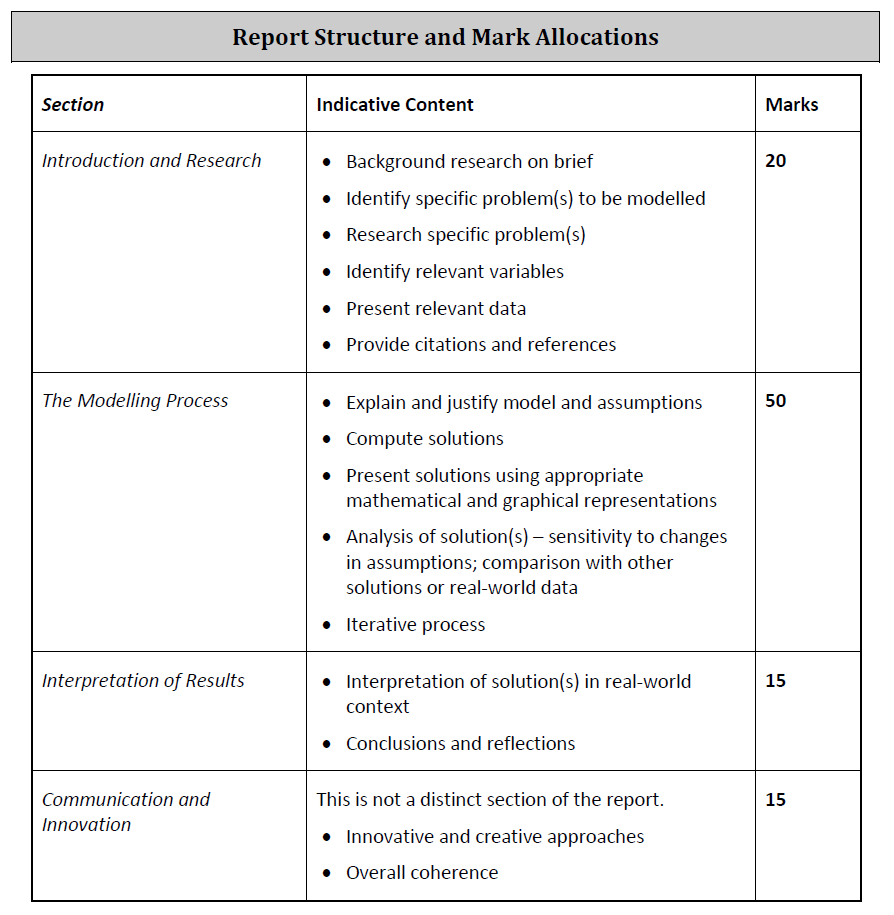
Report Structure and Mark Allocations
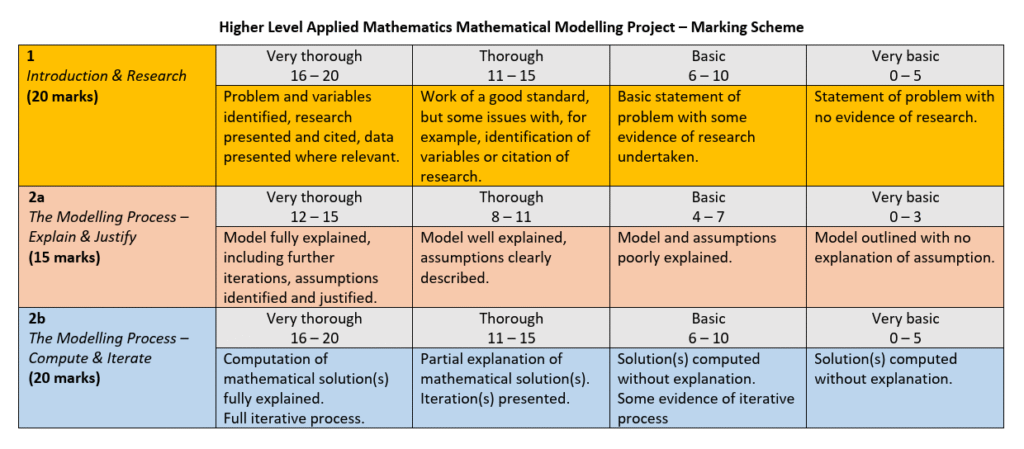
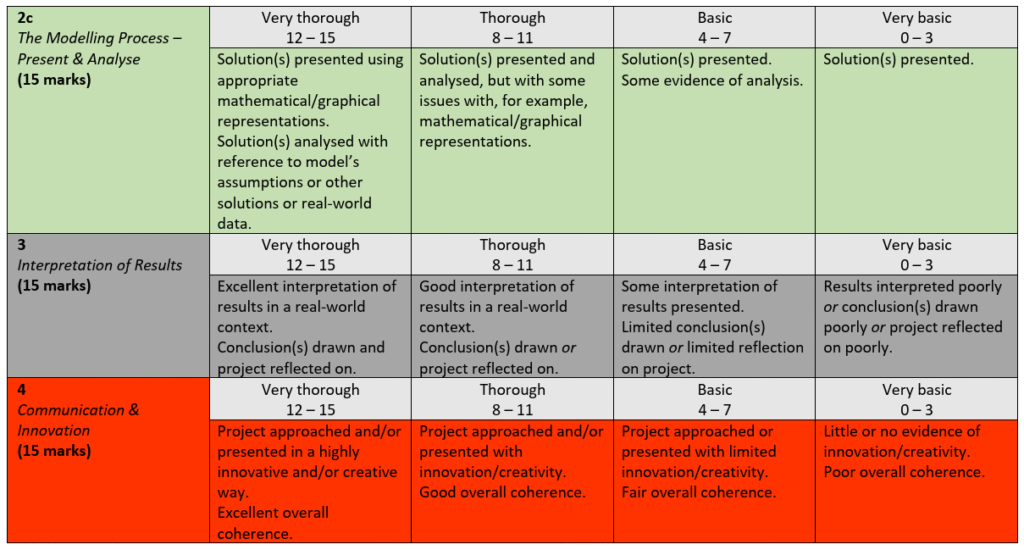
Modelling Project – Marking Scheme
Project Tips Video – How to Excel in Your Modelling Project
This video breaks down exactly what you need to know to succeed in the Applied Maths Mathematical Modelling Project, worth 20% of your Leaving Certificate marks.
Whether you are just starting or refining your report, it is packed with practical insights and tips to help you produce a high‑quality project.
What you will learn:
- Understanding the Modelling Cycle – research, develop, test, refine, and interpret
- Report Structure & Top Tips for each section:
✔ Introduction & Research – identifying variables, gathering data, and citing sources
✔ The Modelling Process – iterations, solutions, and analysis
✔ Interpreting Results – putting your findings in real‑world context
✔ Communication & Innovation – creativity, clarity, and making your work stand out - Real‑Life Example to help you fully understand:
- What “modelling” really means
- How the iterative process works
- How to clearly state and use assumptions
Scaffolded Sample Briefs for 5th Year
I have created two fully‑scaffolded practice briefs designed to give 5th Year Applied Maths students a realistic experience of the Mathematical Modelling Project before they meet the official Leaving Certificate brief.
Each brief mirrors the structure, expectations, and marking scheme of the SEC project, but with additional guidance, prompts, and suggested approaches so students can focus on developing their modelling skills rather than feeling lost at the planning stage.
The two topics are:
- Hammer Throw – Modelling the motion of a hammer throw, starting with basic projectile motion and building in more realistic conditions.
- Stopping Distances – Investigating how braking distance varies with speed, road conditions, and driver reaction time, and comparing results with RSA guidelines.
These briefs give students the chance to:
- Work through the full modelling cycle from research to multiple iterations and reflection
- Apply a range of mathematical techniques to real‑world contexts
- Build confidence in writing a clear, well‑structured report
- See how assumptions, data, and refinements affect their results
They are ideal for practice coursework, summer projects, or class assessments in 5th Year, and can also be used by teachers introducing the project for the first time.
A sample H1‑standard project is available for each brief to show students what an excellent submission looks like.
📩 Request your copy using the form below.
Please note that these projects are not equivalent to the official SEC brief. The modelling steps have been explicitly provided, and the mathematics has been deliberately kept accessible so that 5th Year students can engage meaningfully with the process. The sample projects represent a H1 standard for 5th Year practice work, but they are not intended as 6th Year Higher Level exemplars.
Modelling Throughout the Course
Modelling is not just for the project — it’s a thread that runs through the whole course:
The more you practise modelling in different contexts, the stronger your project (and exam performance) will be.
Support for Teachers
If you are guiding students through the Modelling Project for the first time, I can:
- Provide scaffolded resources and practice briefs
- Suggest classroom activities that build modelling skills
- Help you interpret the marking scheme for maximum student success